This post is part of my Kafka series. If you’re new make sure to check the other posts first.
Network Layer
Surprisingly, Kafka’s network layer is its simplest aspect. It’s designed like an RPC. A message, or in Kafka’s terms, a Frame, is just like a network envelope: header + payload.
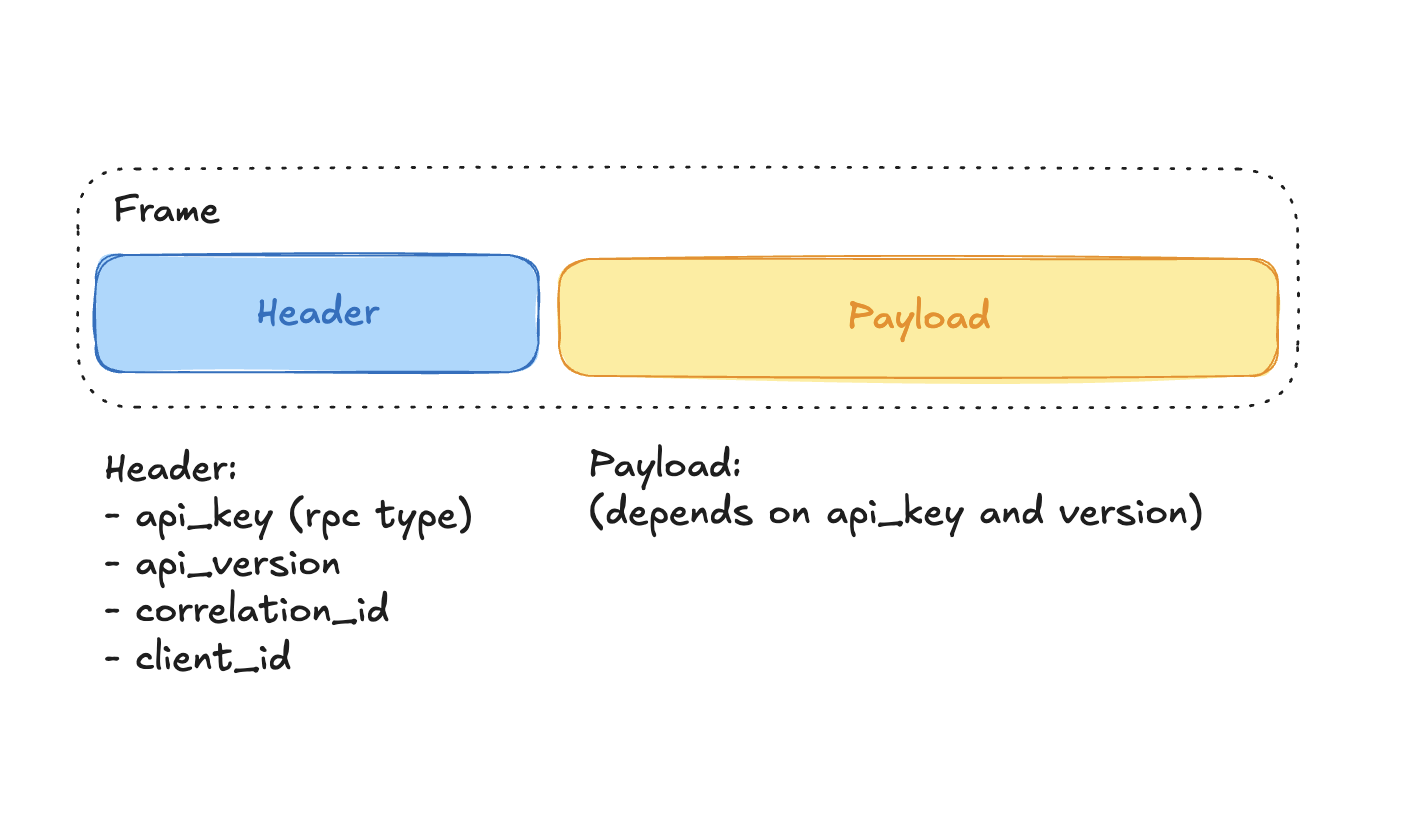
The header carries standard metadata fields found in most protocols. The most relevant is api_key — despite its name, this is not an authentication key but the RPC verb that defines how the payload is decoded.
Here’s a list of the currently supported verbs in my version of Kafka (more coming soon). For a comprehensive list, check the [docs](hint comes here).
Payload
We’ll look at the Fetch Request and Response as examples to understand how the bytes are structured and how versioning is handled.
Fetch Request (Version: 18) => { max_wait_ms min_bytes max_bytes isolation_level session_id session_epoch (topics) (forgotten_topics_data) rack_id cluster_id<tag: 0> replica_state<tag: 1> }
  max_wait_ms => INT32
  min_bytes => INT32
  max_bytes => INT32
  isolation_level => INT8
  session_id => INT32
  session_epoch => INT32
  topics => { topic_id (partitions) }
    topic_id => UUID
    partitions => { partition current_leader_epoch fetch_offset last_fetched_epoch log_start_offset partition_max_bytes replica_directory_id<tag: 0> high_watermark<tag: 1> }
      partition => INT32
      current_leader_epoch => INT32
      fetch_offset => INT64
      last_fetched_epoch => INT32
      log_start_offset => INT64
      partition_max_bytes => INT32
      replica_directory_id<tag: 0> => UUID
      high_watermark<tag: 1> => INT64
  forgotten_topics_data => { topic_id (partitions) }
    topic_id => UUID
    partitions => INT32
  rack_id => COMPACT_STRING
  cluster_id<tag: 0> => COMPACT_NULLABLE_STRING
  replica_state<tag: 1> => { replica_id replica_epoch }
    replica_id => INT32
    replica_epoch => INT64
Fetch Response (Version: 18) => { throttle_time_ms error_code session_id (responses) node_endpoints<tag: 0> }
  throttle_time_ms => INT32
  error_code => INT16
  session_id => INT32
  responses => { topic_id (partitions) }
    topic_id => UUID
    partitions => { partition_index error_code high_watermark last_stable_offset log_start_offset ?(aborted_transactions) preferred_read_replica records diverging_epoch<tag: 0> current_leader<tag: 1> snapshot_id<tag: 2> }
      partition_index => INT32
      error_code => INT16
      high_watermark => INT64
      last_stable_offset => INT64
      log_start_offset => INT64
      aborted_transactions => { producer_id first_offset }
        producer_id => INT64
        first_offset => INT64
      preferred_read_replica => INT32
      records => COMPACT_NULLABLE_RECORDS
      diverging_epoch<tag: 0> => { epoch end_offset }
        epoch => INT32
        end_offset => INT64
      current_leader<tag: 1> => { leader_id leader_epoch }
        leader_id => INT32
        leader_epoch => INT32
      snapshot_id<tag: 2> => { end_offset epoch }
        end_offset => INT64
        epoch => INT32
  node_endpoints<tag: 0> => { node_id host port rack }
    node_id => INT32
    host => COMPACT_STRING
    port => INT32
    rack => COMPACT_NULLABLE_STRING
Simple
You might be thinking: this is not interesting at all. It feels like you just need auto-generated boilerplate to encode and decode each api_key, right?
There are still some interesting questions worth answering:
- How is this compatible with SSL?
- How do we efficiently work with the Protocol in Rust?
SSL
How is this compatible with SSL? This might seem like a stupid question. Why wouldn’t it be compatible with SSL? Well, Kafka’s philosophy, if you’ve read other posts in this series, is really this:
- Bytes over encoding formats.
- Sequential data in disk over memory.
- Avoid copy wherever possible.
Kafka’s initial broker design was to rely on syscalls like sendfile to transfer data from disk directly to the network socket, bypassing user space entirely. The motivation is straightforward: relying on user space as an intermediary at least doubles the I/O work — data must be read from disk into a user-space buffer and then written from that buffer to the socket. More than that, excessive memory use is the first point of failure for a JVM application. If you have had experience with Java or other JVM languages, you’ll know that peaks of memory usage, especially spikes in heap, quickly summon Unexpected Behavior Demons — a no-go for a high-performance application.
Going back to the question. Why is this a problem? sendfile copies raw bytes from a file descriptor straight to a socket in the kernel — there is no opportunity for encryption in this path. TLS/SSL encryption must happen in user space, inside the SSL library running in your process. So when a consumer fetches data over a TLS connection, Kafka cannot use sendfile: it must read the data into a user-space buffer, encrypt it for that specific session, then write the ciphertext to the socket.
The Kafka developers solved this pragmatically: when SSL is enabled, the zero-copy path is simply unavailable. Kafka detects the channel type at connection setup and falls back to a standard user-space loop — read from disk into a buffer, encrypt with the SSL library, write ciphertext to the socket. The same applies in reverse for producers sending data in. This is a known and accepted trade-off: SSL-enabled clusters have measurably lower throughput than plaintext ones, partly because of this. The upside is that the separation is clean — the choice between the sendfile path and the SSL path is made once, not scattered throughout the codebase.
Rust
This is quite an interesting question for a low-level language like Rust, which promises efficient byte management. There are a few options, and I see these approaches not as competing solutions to the same problem but as an evolution of how Rust handles I/O — each one solving a slightly different aspect of it.
Byte slice
We can start by looking at how to parse from a &[u8] byte slice.
Custom Reader
In Go, parsing typically builds around io.Reader: you wrap a net.Conn in a bufio.Reader and call Read or io.ReadFull. In Rust, the equivalent is implementing std::io::Read — a fn read(&mut self, buf: &mut [u8]) -> io::Result<usize> on a struct wrapping the TCP stream. The advantage is genericity: the same parser works against a real socket, a file, or a Cursor<&[u8]> in tests. The problem is that std::io::Read is synchronous. Using it inside an async Tokio runtime means blocking the executor thread, which defeats the purpose of async I/O entirely.
Generic R: Read
The idiomatic Rust step is to make the parsing function generic: fn parse<R: Read>(reader: &mut R) -> Result<Frame, ParseError>. Any type implementing Read works — real sockets, files, or in-memory Cursor<Vec<u8>> for tests. For async code, the equivalent is R: AsyncRead + Unpin using Tokio’s AsyncReadExt. This is more flexible than a concrete custom reader, but the same synchronous-vs-async tension remains: std::io::Read and tokio::io::AsyncRead are separate traits and don’t compose without an explicit bridge.
Stream
Now you say, isn’t a network buffer asynchronous in nature? Shouldn’t we opt for something concurrency friendly, that doesn’t expect the payload to be complete? Shouldn’t we opt for viewing the buffer as a stream and continuously consume bytes until we have successfully parsed the whole Payload? I won’t explain this option in depth, because Kafka’s protocol avoids the stream with a clever trick.
Bytes
Tokio ships a crate called bytes, which has become the standard for handling network byte streams in async Rust. It provides two types: BytesMut — a contiguous, growable buffer — and Bytes, its immutable counterpart. Calling .freeze() on a BytesMut converts it to Bytes. The key feature is cheap cloning and slicing: Bytes::clone() and Bytes::split_to() never copy underlying data — they increment a reference count and adjust the internal offset and length. You fill one BytesMut from the socket, freeze it, then hand off sub-slices to different parts of your parser with no extra allocations. Methods like get_u32() and get_i16() advance an internal read cursor, making sequential parsing a matter of calling methods in field order — exactly what you see in parse_fetch above.
Final Solution
With this whole context, I’ll present the entire flow of how I fill a network buffer, decode the message and do the reverse.
Accept loop
As with any server, the starting point is a TcpStream created for each connection where you pass it to a handler:
async fn accept_loop(&self, ln: TcpListener) {
    loop {
        let (stream, peer_addr) = ln.accept().await.unwrap();
        debug!(%peer_addr, "Received connection from");
        let conn = Connection {
            stream,
            broker: self.broker.clone(),
            read_buf: BytesMut::new(),
        };
        tokio::spawn(async move {
            conn.handle().await;
        });
    }
}
The handler loops, reading frames and writing back the responses the broker returns:
pub async fn handle(mut self) {
    loop {
        let request = match self.read_frame().await {
            Ok(r) => r,
            Err(ConnectionError::Io(_)) => break,
            Err(ConnectionError::Protocol(e)) => {
                tracing::warn!("protocol error: {e:?}");
                break;
            }
        };
        info!(
            api_key = ?request.header.api_key,
            "Handling request for caller"
        );
        let response = match self.broker.handle(request).await {
            Ok(r) => r,
            Err(_) => unreachable!(
                "broker errors should be encoded as ErrorCode in the response body"
            ),
        };
        if let Err(e) = self.write_frame(response).await {
            tracing::warn!("write failed: {e:?}");
            break;
        }
    }
}
Parsing
The interesting part is read_frame, which reads the frame size, resizes a reusable buffer to fit, then calls read_exact to fill it — blocking until all bytes arrive:
async fn read_frame(&mut self) -> Result<Frame, ConnectionError> {
    let size = self.stream.read_u32().await.map_err(ConnectionError::Io)?;
    self.read_buf.resize(size as usize, 0);
    self.stream
        .read_exact(&mut self.read_buf)
        .await
        .map_err(ConnectionError::Io)?;
    Frame::decode(&self.read_buf.split().freeze(), size).map_err(ConnectionError::Protocol)
}
Then, we can decode by parsing the full buffer with a custom decoder:
pub fn decode(buf: &Bytes, size: u32) -> Result<Self, ParseError> {
    let mut decoder = RequestDecoder;
    let mut buf = buf.clone();
    decoder.parse(&mut buf, size)
}
impl RequestDecoder {
    pub fn parse(&mut self, buf: &mut Bytes, size: u32) -> Result<Frame, ParseError> {
        let api_key = buf.get_u32();
        let api_version = buf.get_u32();
        let correlation_id = buf.get_u32();

        let client_id_len = buf.get_i16();
        let client_id = if client_id_len >= 0 {
            Some(
                String::from_utf8(buf.split_to(client_id_len as usize).to_vec())
                    .map_err(|_| ParseError::InvalidClientId)?,
            )
        } else {
            None
        };

        let api_key: ApiKey = api_key.try_into().map_err(|_| ParseError::InvalidApiKey)?;

        let header = RequestHeader {
            api_key,
            api_version,
            correlation_id,
            client_id,
        };

        let body: FrameBody = match api_key {
            ApiKey::Produce => self.parse_produce(buf)?,
            ApiKey::Fetch => self.parse_fetch(buf)?,
            ApiKey::Metadata => self.parse_metadata(buf)?,
            ApiKey::CreateTopics => self.parse_create_topics(buf)?,
        };

        Ok(Frame { size, header, body })
    }

    fn parse_fetch(&self, buf: &mut Bytes) -> Result<FrameBody, ParseError> {
        let replica_id = buf.get_i32();
        let max_bytes = buf.get_u32();
        let topics_len = buf.get_u32();

        let mut topics = Vec::new();
        for _ in 0..topics_len {
            let topic_name_len = buf.get_u16();
            let topic = buf.split_to(topic_name_len as usize);
            let topic = String::from_utf8_lossy(&topic).to_string();
            let partitions_len = buf.get_u32();

            let mut partitions = Vec::new();
            for _ in 0..partitions_len {
                let partition = buf.get_u32();
                let fetch_offset = buf.get_u64();
                let partition_max_bytes = buf.get_u32();
                let high_watermark = buf.get_u64();
                partitions.push(FetchPartition {
                    partition,
                    fetch_offset,
                    partition_max_bytes,
                    high_watermark,
                });
            }
            topics.push(FetchTopic { topic, partitions });
        }
        Ok(FrameBody::Fetch(FetchRequest {
            replica_id,
            max_bytes,
            topics,
        }))
    }
}
This function could be cleaner, but the main logic is there. You match the api_key with another method, which then creates the entire payload by reading sets of bytes with &mut Bytes.
Handling
The broker will handle the request and return a Frame which can then be encoded into a response. This is an important design decision. We could convert parsed frames to domain-specific structs before passing them to the broker, but that would require an extra copy of the record data. By keeping raw Bytes slices inside the Frame and passing it through, record batches can reach disk without being read or copied in user space — preserving Kafka’s zero-copy goal.
Encoding
Once we have a response, we encode it back to bytes.
async fn write_frame(&mut self, res: Frame) -> Result<(), ConnectionError> {
    let bytes = res.encode();
    self.stream
        .write_all(&bytes)
        .await
        .map_err(ConnectionError::Io)
}
This calls Frame::encode, which builds a byte buffer by serializing each field in order.
FrameBody::Fetch(req) => {
    buf.put_i32(req.replica_id);
    buf.put_u32(req.max_bytes);
    buf.put_u32(req.topics.len() as u32);
    for t in &req.topics {
        buf.put_u16(t.topic.len() as u16);
        buf.put_slice(t.topic.as_bytes());
        buf.put_u32(t.partitions.len() as u32);
        for p in &t.partitions {
            buf.put_u32(p.partition);
            buf.put_u64(p.fetch_offset);
            buf.put_u32(p.partition_max_bytes);
            buf.put_u64(p.high_watermark);
        }
    }
}
Conclusion
That’s all on the Kafka protocol and its Rust implementation. If you have questions, look at the code and try replicating it with a simpler protocol to see it in action.